Since our last posting in mid January - and we did say that we wouldnt be regular! - things have been quiet (other than the monster find of a winter Wilson's Petrel by James which he talked about here). There are several reasons for that - mostly because its been mid-january and February and that's hardly peak season for anything. But also because some of us got away from Cornwall for a bit leaving a couple of stalwarts to man the barricades and keep the year list going. A site record (probably) of 450 Fulmar on February 18th and on the same day, a very early House Martin by Billy gripped several of us off. An immature, probably 2CY, Iceland Gull passed The Island and flew into the bay on the 22nd which was another Billy find.
OK, so anyway, back to St Ives birds. On the 28th February a big turn out of Alan, Liam, Billy and Steve had a great day of 111 Red-throated Diver moving around offshort - going west, east, in and out of the bay - including a "flock" of 16 RTDs all heading west at one point. (What IS the name for a group of divers??) Later that day, after ticking off the Dusky Warbler (finally after about 10 attempts) at Boscathno Reservoir, we found a male Hen Harrier within the St Ives 20K boundary. We're not about to share sensitive news about where this special bird is hanging out - but it won't take a genius to work out that Hen Harriers like undisturbed moorland/farmland habitat (of which there is loads in West Cornwall) - so go out there and find it yourself! Or another one ... there's probably a few knocking about West Penwith in various locations.
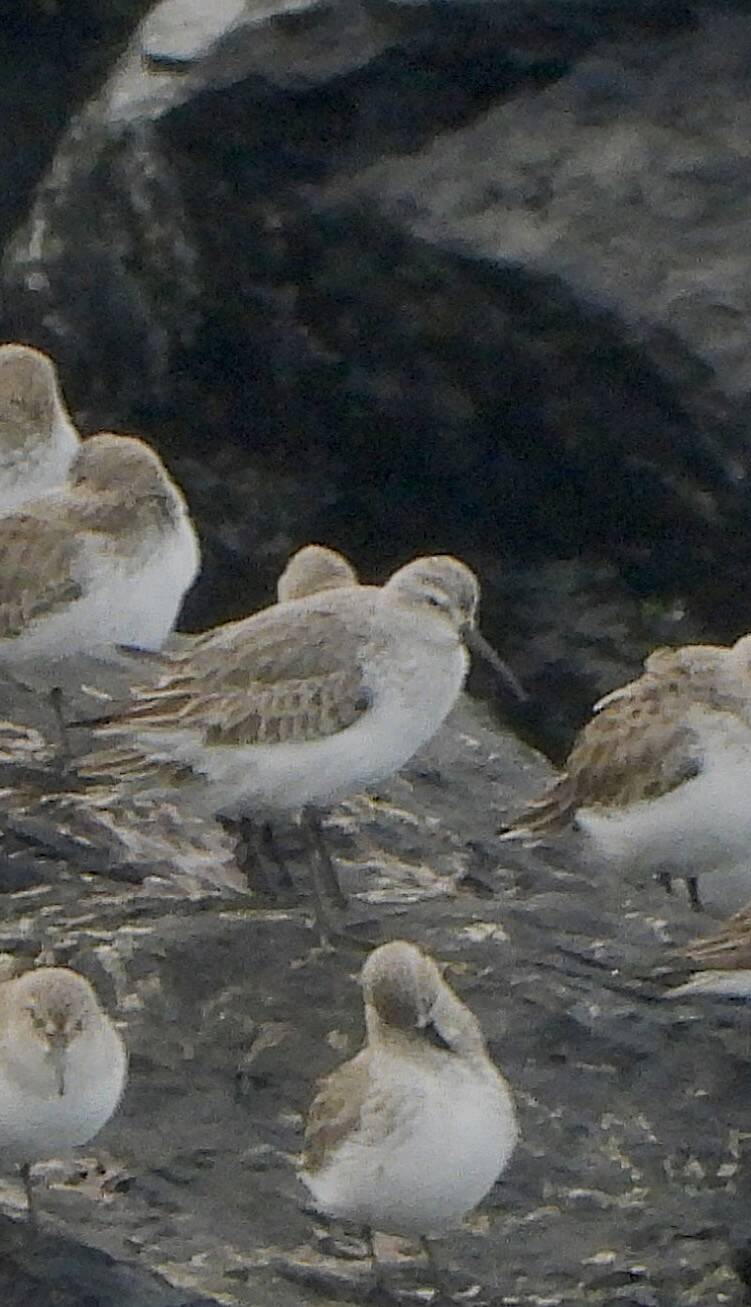
But all of that is nothing, nothing i tell you, to the events over the evening of March 4th and early morning March 5th. There's usually a few waders hanging around The Island at roost time and occasionally, there are larger number of Dunlin and sometimes Sanderling. They tend to like the rocks of Porthgwidden mostly. Anyway, on the evening of March 4th, a small flock of waders flew backwards and forwards across the north side of The Island clearly looking for a place to roost. As i scanned them i saw that they were mostly Dunlin and within them were 5 "Purps" ... and boom! ... there was one with a WHITE RUMP! Curlew Sandpiper!! A St Ives MEGA!! Calls were made, texts were sent, dinners were left for the dog, relationships were put on hold, work was told to stuff it ... and most of us managed to connect with it before it got too dark. That night, we'd arranged for a St Ives Birders drinks in the Pilchard's Press ... (Rum and Shrub cocktails are our drink of choice if you're asking - other pubs are available) .. and so we toasted the addition of a well-earned tick ... and talked about the outlandish, ridiculous, stupid possibility of a Pacific Diver drifting past The Island during our planned early seawatch the next day.
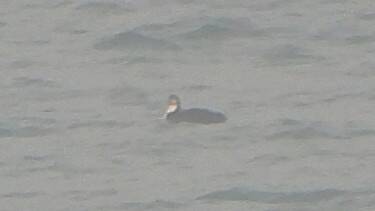
The next day, on our planned early seawatch, a Pacific Diver drifted past The Island! Honestly, it did! Liam picked it up as a small, "black-throated" type in front of The Island and we all watched, rather increduously, as this small, only-a-bit-bigger-than-a-Gulllemot, weak billed, dark-flanked, chin-strapped Pacific Diver drifted past us on the ebbing tide! We dashed for various cameras and were able to fire off some shots which are absolutely terrible ... as you can see below. But, hey - they're good enough in our opinion.
What was possibly even more exciting was 5 minutes after Liam mentioning that he's never had a Magpie on The Island - a perfect Magpie flew up from the scubby area, performed a couple of loops and then swept off towards Porthmeor.
3 Island megas in about 12 hours. Scenes!
In the words of the famous poem - to be read aloud in a strong Noo Yoik accent by the way - "Spring has sprung, da grass has riz - i wonder where da boidies iz" (Google it, kidz) ... well, there are quite a few "boidies" in West Cornwall and we plan to find as many of 'em as we can in the coming weeks.


Add comment
Comments