On the 26th January, one of our esteemed members, James - finder of rare Swifts and Hirundines, found a petrel flying around off Eastern Green Beach between Penzance and Long Rock basically. Any petrel in January is rare - and we believe this to be a Wilson's Petrel. Now, the more astute amongst you will know that Eastern Green beach is somewhat outside our self-defined St Ives Birders area. Top marks for being geographically aware and on the ball! We post this account by James himself more as a record of this remarkable sighting, and also because we have a feeling given the current progress on Wilson's taxonomy that this record may well become more important over time... and, you know, because James is one of our own!
A Winter Wilson’s 26/01/26
I was sea-watching at Eastern Green, Mounts Bay (and wishing I was somewhere else) because my car was in the shop, getting repaired in Long Rock, and I had hours to kill and nowhere to go. So I trudged down to the beach with my scope and camera, the thick mist-rain unable to dampen a faint glow of optimism at the opportunity to birdwatch outside Zennor or St Ives for the first time this year. As luck would have it a strong southerly hinted at seabirds being blown into the bay and on the short walk to the crossing over to the beach I thought about Leach’s Petrels, Pomarine Skuas and Little Gulls. There were also innumerable Pacific Divers to be seen in the bay at that time.
The rain cleared as I set up my scope near the sea wall – a place to shelter if it came back. Mounts Bay welcomed me with a close Great Northen Diver, but even that hulk of a bird kept disappearing behind large waves and I held tight onto my scope to keep it steady as I struggled to relocate it. I had just spotted two more distant divers when a small, busy, black bird with a clear white rump bowled into view, flying into the wind. A petrel! Always exciting, even in the summer when they can be plentiful. I hadn’t really thought I’d be lucky enough to see one.
Despite being relatively distant it was clearly big for a petrel, and in typical petrel fashion it immediately disappeared. I picked it up again and we started a game of hide and seek where I would watch the bird for a few seconds and before it would vanish again – I think to sit on the sea. During these initial views I noted a large looking petrel with quite a strong flight (into the wind) an obvious white rump, all dark underwings and easily visible pale covert bars which I thought was all fine for a Leach’s Petrel. What got me especially interested in the bird was that it appeared to have a square tail, and not a forked tail like a Leach’s Petrel. In my experience this can be hard to distinguish, especially at range and in poor viewing conditions which was the case, but now on multiple occasions it had looked square and there was something about the way it flew that seemed a little off. I seized an opportunity while the bird was out of sight to text a birding whatsapp group asking about the likelihood of a Wilson’s at this time of year, knowing they are occasional visitors in the summer months, I assumed they must very rarely be seen in the winter. I did not expect to be told there had never been a winter record in the UK, in fact none at all outside of May-October!
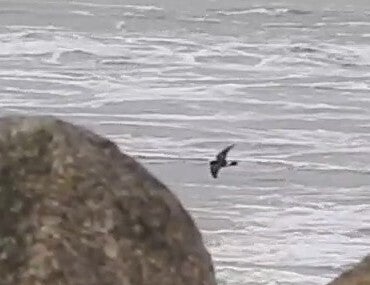
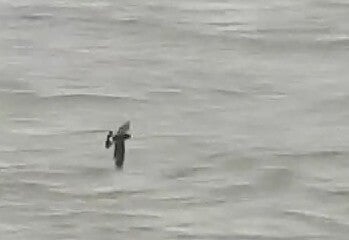
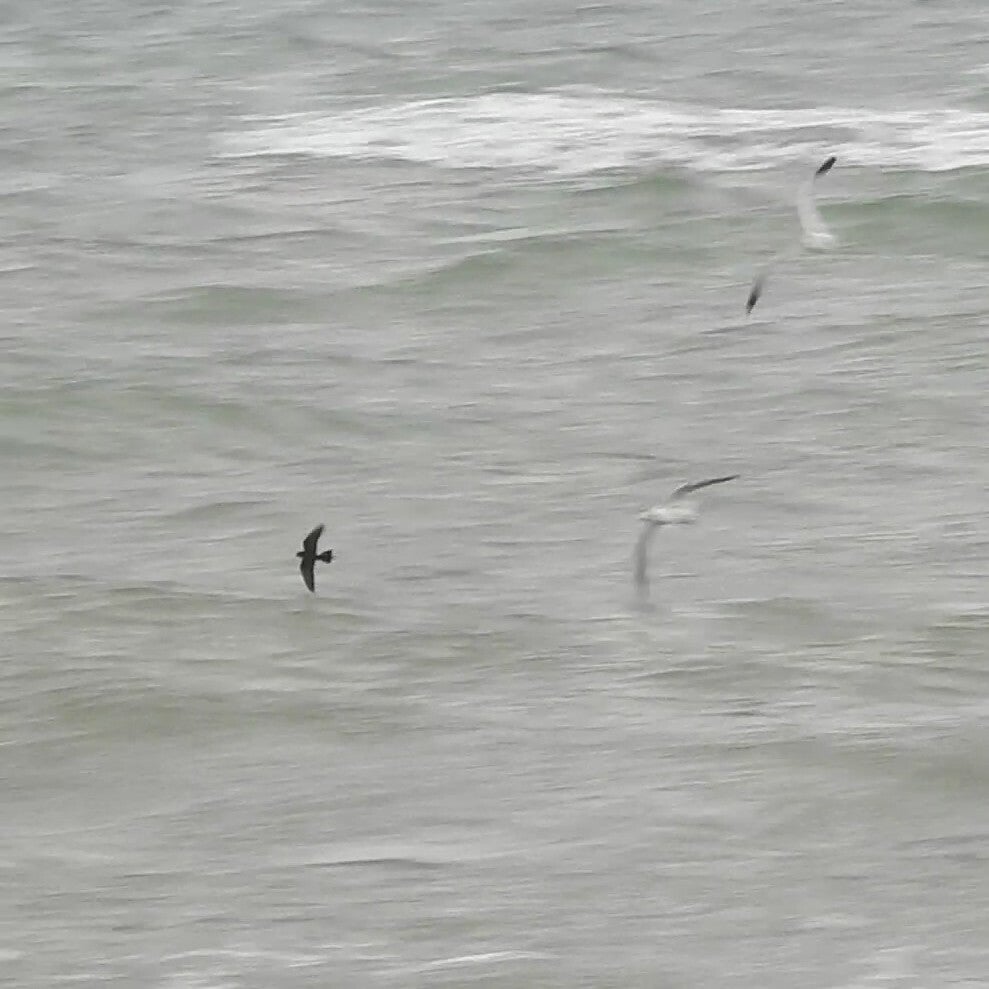
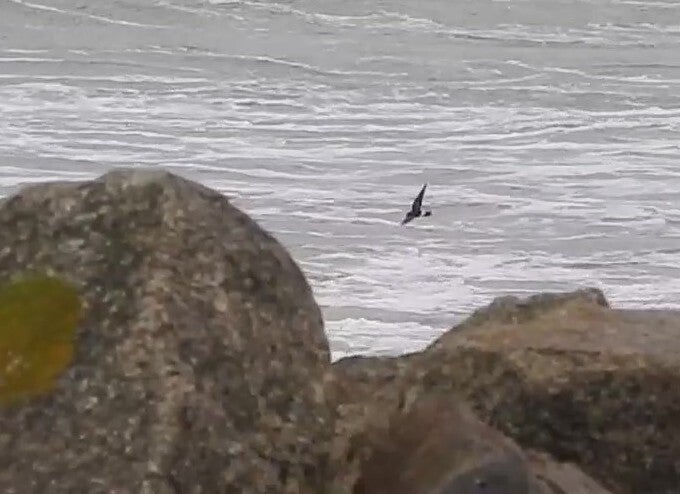
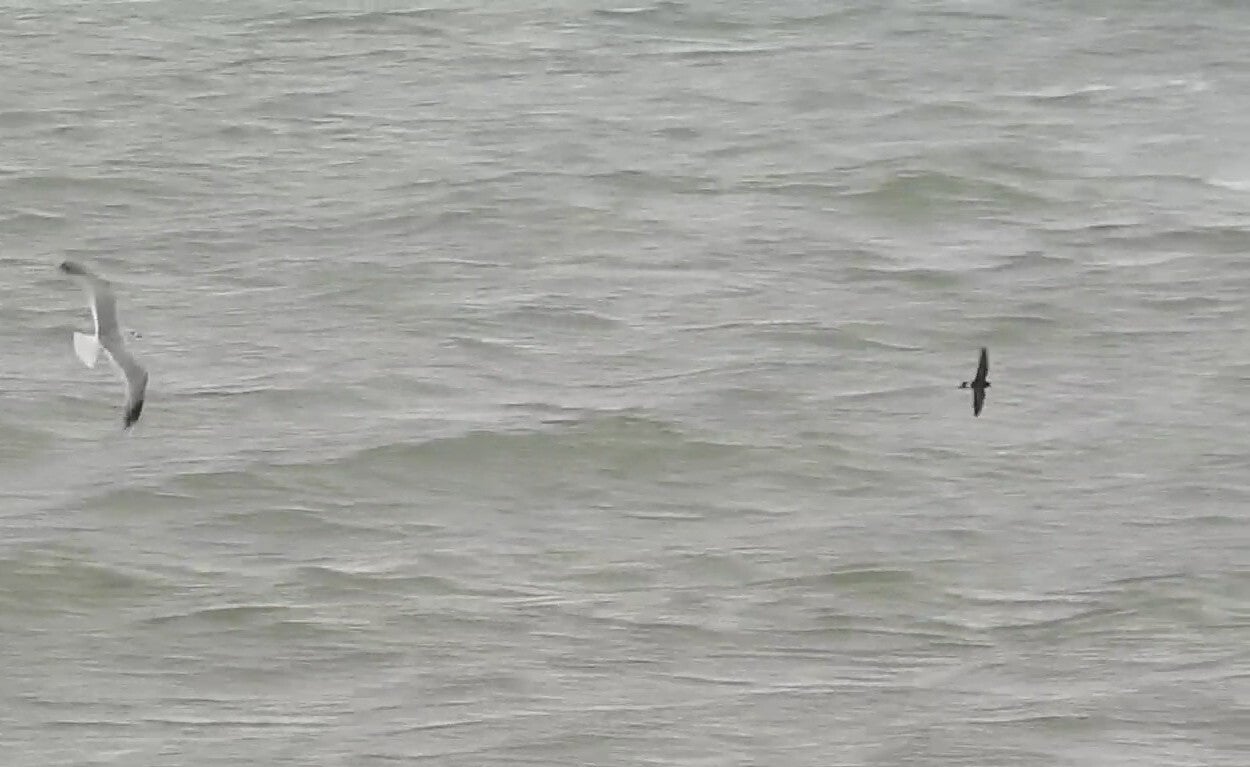
So I put Wilson’s out of my mind as too improbable and returned to looking for the bird. It then appeared much closer, being determinedly harried by a few gulls. I watched it duck and dive to avoid them, looking powerful and agile and decidedly square tailed. I began to consider Band-rumped Petrel which didn’t take long as I know so little about them! What I do know is they are extremely rare here, that the term covers a group of birds with varying plumage details and that I was in no way qualified to claim to have seen one. Naturally then, with the bird being now much closer I got my camera out and did my best to capture the bird using a combination of photo and video. It’s hard getting shots of sea birds at the best of times but in the strong wind and with the pace of the chase, with the petrel weaving this way and that between the circling gulls I did the best I could. In what felt like a lot of chaos the bird suddenly escaped the gulls and flew steady and parallel to me briefly very close by. This was my moment to get a decent picture! Focus! But my camera wasn’t working, it wouldn’t take any photos! And I realized I had left it recording a strange and chaotic video. And then the bird was gone. The thick mizzle returned promptly and I could hardly see the sea at all.
Sheltering behind the sea wall I thought about what I had seen. I thought the bird must have been a Leach’s, and in the wind-shaken scope and as it dodged gulls for its life the forked tail must have been very hard to see. I quickly checked a few photos in the rain and the rump didn’t look like it was supposed to for Band-rumped, it looked too large and who was I kidding I was never going to claim one even if I thought I had seen one. In some photos it appeared to show toe projections but I wasn’t sure if this was the photos being deceptive, perhaps the tail at a strange angle? So I put the bird out to the birding world as a Leach’s, in case anyone might look from elsewhere in the bay. I mentioned my needling reservations in a couple of Whatsapp groups and promised to send my photos to them when I got home. About 45 minutes later I was still there (it was really raining!) and news came through of someone else seeing a Leach’s in the bay and that was reassuring. I had made the right call, until I got home that evening.
I looked through my photos with a familiar feeling of disappointment. Blurry, very blurry, birdless, blurry and birdless. The videos however came out better and I managed to slow them down and get a couple of half decent still frames out of them. They all confirmed what I had seen in the field. I sent them around to some friends and Wilson’s Petrel was again mentioned and again dismissed as improbable. In all the photo admin and messaging I had forgotten to submit the sighting properly to the Cornwall sightings website. I was encouraged to submit it with a photo, knowing that right-minded Cornish birders wouldn’t be able to resist looking at a photo of a Leach’s Petrel. I didn’t think anything would come of it.
Cornwall has as many birding Whatsapp groups as it has birdwatchers and one of them must have been discussing the petrel as I simultaneously got a messages from St Ives Birder in chief Liam, as well as a local bird group asking for more images. It looked like a possible Wilson’s was the thinking, much to everyone’s surprise. I knew my images weren’t great so I didn’t hold out much hope but luckily for me some birders have incredible skill and experience and with some confidence ID’d my images as seemingly the first winter record of Wilson’s Petrel for the UK. Thank you to everyone for helping to make the identification. Alan has described it as the first possible ‘Antarctic Wilson’s’ for the western pal – I think I’ll let him explain what that means in a post script!
Cornwall reminds me annually to expect the unexpected. In my first week here a Wryneck hopped out of a bush at the end of my road – in December! Last year a Swift flyover - in January! An now a January Wilson’s Petrel, the first winter record for the UK. You never know in Kernow.
Add comment
Comments